Pictet - A new era in the fight against climate change
The International Court of Justice has ruled that countries are legally obligated to protect our climate and prevent harm to it. What are the implications for business and investments?

In July this year, the battle to combat climate change entered a new phase. It was then that the United Nations’ highest court issued a landmark opinion stating governments had a legal duty to protect the environment.
According to ClientEarth, a non-profit group of lawyers that has built a formidable reputation for holding governments and companies to account over climate change, nature loss, and pollution, the decision could have wide implications not only for official policy, but also for businesses and investors.
“The court found that the protection of the environment is a precondition for the enjoyment of human rights, which is crucial … The court was at pains to make that this isn't just about the climate, it's about nature as well,” says Adam Weiss, Chief Programmes and Impact Officer at ClientEarth.
“With governments held accountable, there is more incentive for them to enforce regulation on businesses and to create new, stricter rules.”
In its ruling, the International Court of Justice (ICJ) said that “states have a duty to prevent significant harm to the environment by acting with due diligence and to use all means at their disposal to prevent activities carried out within their jurisdiction or control from causing significant harm to the climate system and other parts of the environment”. [1]
Climate change treaties, such as the Paris Agreement, set out binding obligations for countries which have signed them, on issues including the mitigation of greenhouse gas emissions, promotion of climate change adaptation measures and support for biodiversity.
Courts for Climate
Court cases
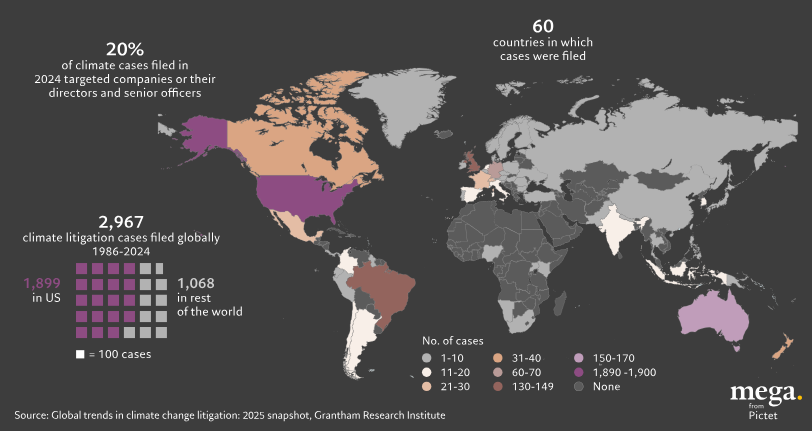
The ruling opens the door to more legal action to ensure these obligations are met. To date, over 3,000 climate cases have been filed in 60 countries. ClientEarth has been involved in many of them. This year alone, the actions it brought saw Dutch carrier KLM found liable for making misleading climate-related claims in its marketing, the UK government’s climate strategy declared not fit for purpose and Portugal abandoning plans to build a new airport.
So far, the majority of court cases have targeted government bodies, but that could change, Weiss says.
“Basically, the International Court of Justice has opened up the possibility that there can be lawsuits between countries because of the damage caused by climate change,” he explains.
Thus, a poor country suffering the impacts of climate change could in theory sue a rich country which contributed to environmental deterioration. An international court could then rule that the rich country should stop the detrimental actions, and, on an exceptional basis, could possibly even award compensation.
“I think the ICJ opinion strengthens the hand of anyone trying to bring an attribution kind of case because what the opinion says is it's theoretically possible” Weiss says.
Yet because such cases would be complicated and difficult to bring to court, a more probable consequence would be more action against companies – which in 2024 were the targets of just 20% of all climate-related litigation. Global trends in climate change litigation. [2] That, in turn, will have consequences for financial markets.
We are likely to see more “people who are responsible for corporate conduct being held to account for whether their actions line up with their words and, more importantly, whether their actions add up to what we need to do to reach the Paris goals,” Weiss says.
“We will see that certain business models are simply not viable anymore… If I were working for a finance company, my investment in a fossil fuel company [would start] to look shakier because one of those companies is going to be held liable and have to pay damages. And if I were a bondholder in a country that's violating climate laws in a really obvious way, I might be thinking about that as well.”
[1] Obligations of States in respect of Climate Change
[2] Global trends in climate change litigation: 2025
Important Information
This article is used for informational purposes only and does not constitute on Pictet Asset Management part, an offer to buy or sell solicitation or investment advice. It has been established on the basis of data, projections, forecasts, anticipations and hypothesis which are subjective. Its analysis and conclusions are the expression of an opinion, based on available data at a specific date. The effective evolution of the economic variables and values of the financial markets could be significantly different from the indications communicated in this document.
December 2025
Please note that these are the views of the Chief Programmes and Impact Officer, ClientEarth, in conversation with Pictet and should not be interpreted as the views of RL360.